≽ Francisco Goya
Francisco Goya was a Spanish Romantic painter and printmaker. Widely regarded as one of the most important Spanish artists, Goya was able to transition for an "Old Master" to a great of the modern portraitists with ease.
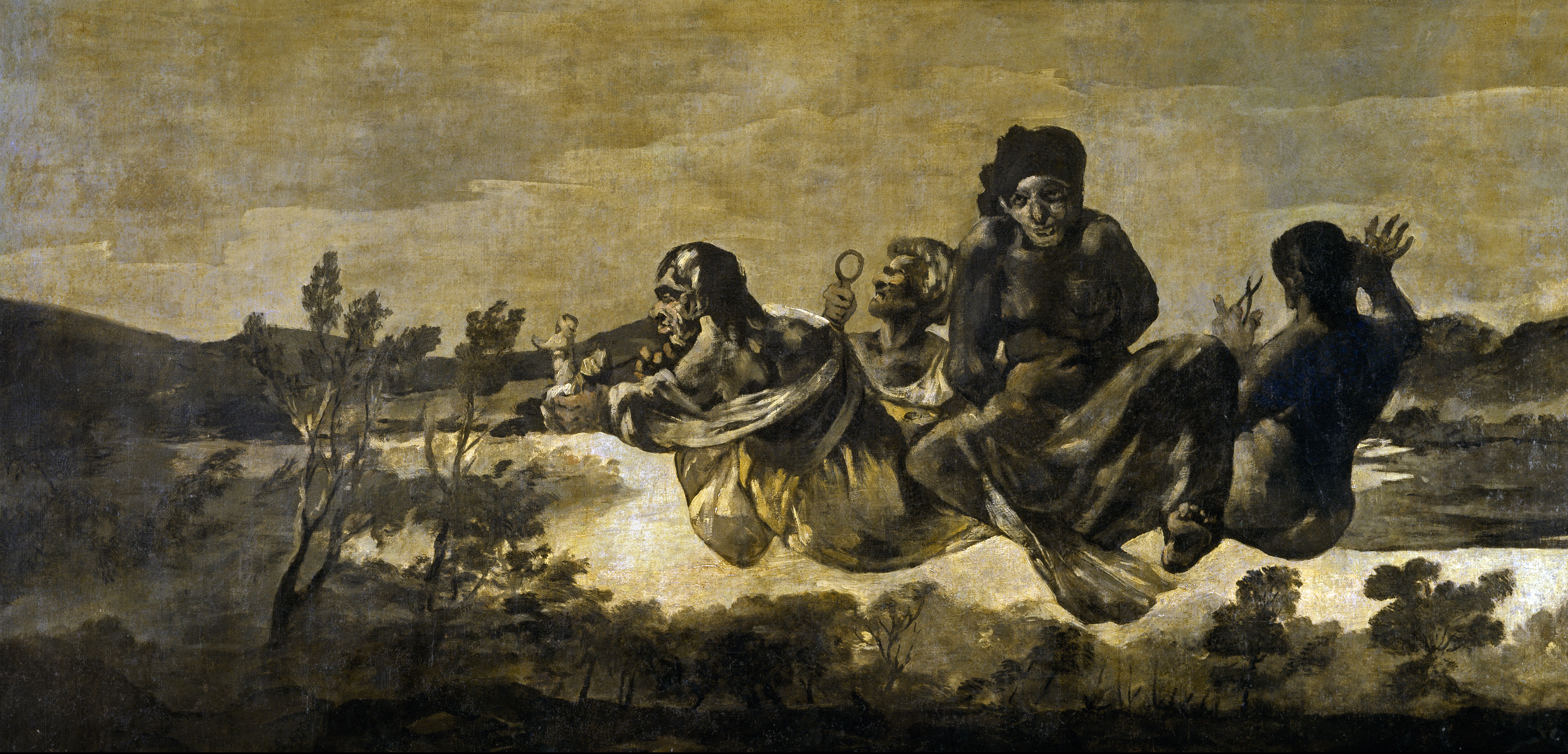
≽ Atropos (The Fates)
From Goya's 14 "Black Paintings", Atropos or "The Fates" stood out to me.
PAINTING'S STATISTICS:
- Title: Atropos (The Fates)
- Date: 1821 - 1823
- Dimensions: 123 cm x 266 cm
- Medium: Oil on plaster, mounted on canvas
The subject matter for this particular painting is often considered as a reinterpretation of the mythological goddesses of destiny. Also known as the "Moirai", these goddesses would spin the thread of ones life, the length of its life, and finally, the goddess Atropos, would cut this thread ultimately judging in how one dies. Seeing the name Atropos sparked my interest as I had taken a mythology course just last semester, and seeing a secondary interpretation of these figures I believed would be interesting. Overall, Clotho can be seen creating a doll, Lachesis is holding a mirror or lens, and commonly Atropos is wielding a pair of scissors. What is interesting about this interpretation is that there is a fourth figure, a man that seems to have his hands tied behind his back. Many have seen this as Goya presenting the case that one is forced into this predicament, and that only death is guaranteed in one's destiny.
≽ Que viene el Coco (Here Comes the Bogey-Man)
Choosing a particular work from "The Caprichos" was quite a challenge. Many are very distinct and interesting, but having been fascinated by the legend of the "Boogeyman", I decided to focus upon Que viene el Coco.
PAINTING'S STATISTICS:
- Title: Quiene viene el Coco (Here Comes the Bogey-Man)
- Date: 1797 - 1798
- Dimensions: 21.9 cm x 15.4 cm
- Medium: Etching and aquatint on laid paper
Seeing as the legend of the Boogeyman has sparked an interest, I took a liking to this particular work not only for its interesting visual style, but perhaps to learn more about how Goya may have integrated this legend into his
Caprichos. But to be quite honest, finding any source or text upon a possible meaning for nearly any of the
Capricho has been a formidable task. I then thought perhaps it has something to do with the timeline of these etchings, but I could not see a clear distinction of plot or continuity. Nonetheless, this work still attracts my eye due to its distinctive yet horrific use of lighting and mystery to convey truly unnerving emotions.
.jpg/1200px-Goya_-_Que_viene_el_coco_(Here_Comes_the_Bogey-Man).jpg)
Comments
Post a Comment